


Biofilm is more than just a microbiological problem. It is an active system of micro-organisms that constantly interacts with the materials used to construct pipes, tanks and installations. Biofilm consists of bacteria that attach themselves to a surface and protect themselves with a sticky layer of mucus. This layer ensures that bacteria adhere firmly and are difficult to remove. Research by Yang et al. (2023) shows that this interaction between biofilm and surface materials plays a crucial role in the development and persistence of biofilm. The properties of the material itself, such as roughness, surface energy and water repellency, largely determine how quickly biofilm can form and how deeply it can anchor itself in the surface.
Biofilm alters the surface
What is often underestimated is that biofilm actually “hides” the original surface of a pipe or installation. As soon as bacteria attach themselves, a so-called conditioning layer is created. This layer masks the properties of the underlying material and creates a new, biologically active surface on which other bacteria can settle even more easily (Yang et al., 2023). This not only increases contamination, but also changes the behaviour of the system. Biofilm can lead to impaired flow, increased corrosion and a greater risk of biofilm particles detaching and reattaching elsewhere in the system. This makes the surface increasingly susceptible to recontamination and increases resistance to biocides and antibiotics.
Why cleaning alone is not enough
Once biofilm has developed, the slime layer protects the bacteria from external influences. This means that standard cleaning agents or a general disinfection step often have insufficient effect. The biofilm remains intact, while only some of the free bacteria are tackled. The research by Yang et al. shows that effective biofilm control requires agents that not only kill bacteria, but also actually attack the biofilm structure and detach it from the surface. It is precisely this combination that is essential to “free” the original material and prevent new adhesion.
Aqua-clean: effective against biofilm AND bacteria
Whereas conventional peroxide solutions mainly work oxidatively, the power of Aqua-clean lies in its ability to break down biofilms and effectively kill bacteria. By actually damaging the biofilm structure, the protective mucus layer is broken down and the surface becomes accessible again for thorough cleaning.
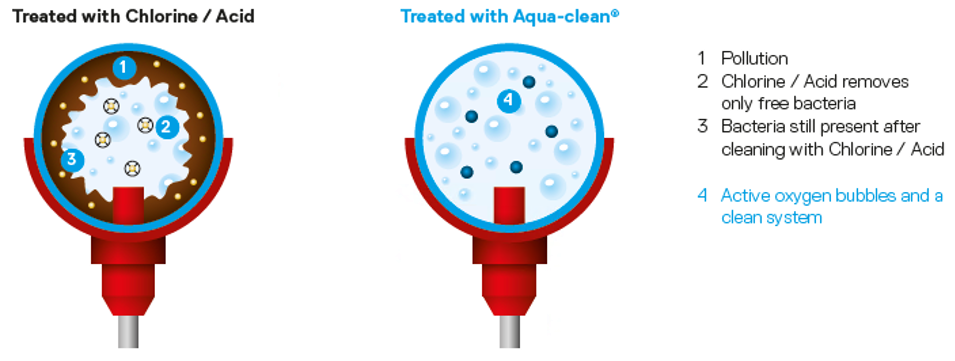
This is in line with the findings of the study by Yang et al. (2023), which emphasises that successful biofilm control revolves around disrupting adhesion, breaking down the biofilm matrix and restoring the surface. Aqua-clean fits within this approach and makes it possible not only to clean pipe systems, but also to keep them structurally clean.
A different take on biofilm control
By viewing biofilm not only as a microbiological problem, but as an interaction between microorganisms and surface materials, a different perspective on hygiene in drinking water systems emerges. The choice of materials, surface properties and the right cleaning agent together determine the result. At Kanters, we combine these insights with practical experience. This allows us to translate scientific knowledge about biofilm and surface materials into effective, applicable solutions such as Aqua-clean. This ensures that systems remain clean, safe and reliable.
Conclusion
Research by Yang et al. (2023) shows that biofilm does not simply “sit” on a surface, but actively changes it. This explains why biofilm is so stubborn and why effective cleaning must go beyond standard disinfection. By structurally breaking down biofilm and killing bacteria at the same time, Kanters helps companies maintain control over their piping systems, both today and in the long term.
Source
Yang, H., Xu, Z., Xu, Z., & Li, Y. (2023).
Mini-Review of Biofilm Interactions with Surface Materials in Industrial Piping System. Membranes, 13(2), 125. https://doi.org/10.3390/membranes13020125