

Históricamente, los ácidos orgánicos se han utilizado para la conservación de alimentos, y en el pienso de los animales para proteger del deterioro microbiano y frente al crecimiento de levaduras y mohos. Hoy en día, los ácidos orgánicos están presentes en la industria de piensos en una amplia gama de formas y composiciones. Además de preservar el pienso, el refuerzo de la salud intestinal se ha convertido en un objetivo importante. La variedad de ácidos orgánicos entre la que elegir se ha vuelto abrumadora pero, ¿qué diferencias hay entre las opciones disponibles?
Efecto del pH en el microbioma

La atención prestada a la salud digestiva en las publicaciones y las investigaciones científicas ha crecido considerablemente. De hecho, la salud digestiva es una necesidad para lograr una disminución significativa en el uso de antibióticos. El papel de las bacterias intestinales va más allá de la fermentación de nutrientes. Cada vez más investigaciones están desentrañando la compleja interacción entre las bacterias y el sistema inmunitario del anfitrión donde viven.

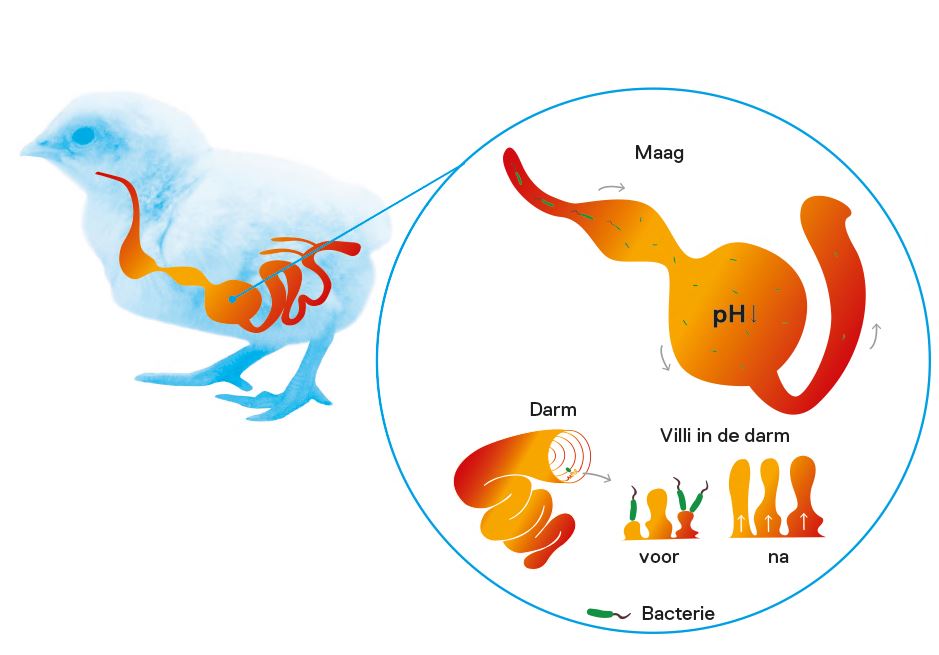
Qué organismos microbianos viven en el tubo digestivo, lo que se denomina microbioma, viene determinado por diversos factores. Un importante factor es el pH de los contenidos del tubo digestivo. Las bacterias difieren en su tolerancia a un pH bajo. La salmonela, por ejemplo, tolera menos los ácidos que una especie de lactobacilus. En otras palabras, si las mezclas de ácidos orgánicos afectan al pH, también afectan a la composición del microbioma.

Ácidos fuertes y débiles

Los ácidos orgánicos difieren en su acidez. Esto presenta un efecto directo sobre su comportamiento en el tubo gastrointestinal. Los ácidos fuertes ceden “ávidamente” su molécula H+, lo que acidifica lo que les rodea. Esto sucede en parte en el agua a la que se añaden y en parte en el estómago. Los ácidos débiles, por otra parte, retienen parte de sus moléculas de H+ y pueden, por tanto, seguir acidificando activamente en la primera porción del intestino delgado. Un ácido orgánico compuesto debe tener, idealmente, un efecto en el agua, el estómago y el intestino.

Ácidos tamponados y no tamponados

Existe también una diferencia entre los ácidos orgánicos tamponados y ácidos orgánicos no tamponados. Los no tamponados tienden a disociarse más fuertemente que los tamponados. El poder de acidificación es el mismo, pero los ácidos tamponados se inactivarán (= disociarán) solo parcialmente después del estómago y por tanto influirán en la primera parte del intestino.

kuiken, water, kanters, darmgezondheid

Sabor

Cada ácido orgánico tiene su propio sabor. Esto es posiblemente la razón que explica que aunque la mayoría de los fabricantes de ácidos indican una dosis recomendada de pH = 3,5 a 4, otros fabricantes advierten de que el pH no debe ser inferior a 5. Aunque la apetitosidad es obviamente muy importante, el riesgo de contaminación bacteriana en agua con ácidos orgánicos es significativamente menor cuando el pH es inferior a 4.

Kanters y los ácidos orgánicos

Las diferencias anteriormente mencionadas entre los ácidos orgánicos no está completa. Nos llevaría mucho tiempo explicar todas las diferencias aquí. Durante los últimos 35 años Kanters se ha especializado en el uso de ácidos orgánicos para ayudar a la salud de los animales y su producción. Para cada situación específica (calidad del agua, especie y edad del animal, sistema ganadero, etc.) hay una mezcla específica de ácidos que es la adecuada.

Para más información, llame al 0499-425 600 o diríjase por correo electrónico a mailto:info@kanters.nl

Historically, organic acids have been used for food preservation, in animal feed to protect against microbial deterioration and the growth of yeasts and moulds. Today, organic acids are available in the feed industry in a wide range of forms and compositions. In addition to feed preservation, the support of intestinal health has become an important goal. The choice of organic acids is overwhelming, but what is the                                                       difference between them?

Effect of pH on microbiome

The attention paid to gut health in journals and scientific research has grown enormously. In fact, gut health is a necessity for achieving a significant reduction in antibiotic use. The role of gut bacteria goes beyond the fermentation of nutrients. More and more research is unravelling the complex interaction between bacteria and the immune system of the host in which they live.

Which microbial organisms live in the gut, the so-called microbiome, is influenced by several factors. One important factor is the pH of the contents of the intestinal tract. Bacteria differ in their tolerance for a low pH. Salmonella, for example, is less acid tolerant compared to Lactobacillus species. In other words, if organic acid mixtures affect the pH, they also affect the composition of the microbiome.

Strong and weak acids

Organic acids differ in their acidity. This has a direct effect on their behaviour in the gastrointestinal tract. Strong acids ‘gladly’ give away their H+ molecule, thereby acidifying their surroundings. This happens partly in the water to which they are added and partly in the stomach. Weak acids, on the other hand, retain part of their H+ molecules and can therefore still actively acidify in the first part of the small intestine. A compound organic acid aims to have an effect in the water, the stomach and the intestine.

Buffered and unbuffered acids

There is also a difference between buffered organic acids and unbuffered organic acids. The unbuffered organic acids tend to dissociate more strongly than buffered acids. The final acidifying power is the same, but buffered acids will partly only inactivate (= dissociate) after the stomach and thus influence the pH in the first part of the intestine.

kuiken, water, kanters, darmgezondheid

Taste

Every organic acid has its own taste. This is possibly an explanation for the fact that although most acid manufacturers give a recommended dosage of a pH=3.5 to 4, other manufacturers advise not to let the pH drop below 5. Although palatability is obviously very important, the risk of bacterial contamination of water with organic acids is significantly less when the pH is lower than 4.

Kanters and organic acids

The above-mentioned differences between organic acids is incomplete. It would go too far to explain all the differences here. During the last 35 years Kanters has specialised in the use of organic acids to support animal health and production. For each specific situation (water quality, animal species, age, husbandry system, etc) a specific acid mixture is most suitable.

For more information, please call 0499-425 600 or send an e-mail to mailto:info@kanters.nl